⚠️ This page connects you to Atovia’s partners and affiliate markets. We may receive a commission from affiliate partners for activities made through these links. Discount offers may change at any time according to policy! Rest assured, there are no additional costs to you! We hope this saves you time in finding the right items!
You have a recipe, a grocery receipt, and no idea what one serving actually costs. This guide walks through one repeatable method, from ingredient prices to a per-serving number you can trust.
- The Basic Recipe Cost Formula
- Step 1: List Every Ingredient With Its Exact Amount
- Step 2: Find the Unit Price of Each Ingredient
- Step 3: Match Your Units Before You Multiply
- Step 4: Adjust for Trim Loss and Yield
- Step 5: Add Up the Batch and Divide by Real Servings
- Full Worked Example: From Receipt to Cost Per Serving
- Costing Sauces, Stocks, and Other Sub-Recipes
- From Cost Per Serving to Food Cost Percentage
- Common Mistakes That Make Your Recipe Cost Too Low
- FAQ
- Quick Recap and Your Next Step
- Batch cost is the sum of (amount used × unit price) for every ingredient.
- Cost per serving is batch cost divided by the servings you actually produced.
- Match units first, then adjust for trim loss using yield.
- Ingredient cost is not total cost and not profit.
The Basic Recipe Cost Formula
To cost a recipe, multiply each ingredient’s used amount by its unit price, then add everything up. That is the whole idea, and every step below just makes those two inputs more accurate. [S1]
Then divide that batch total by the number of servings the batch really yields. [S1][S2]
Batch cost = sum of (amount used × unit price)
Cost per serving = batch cost ÷ servings produced
One caution before we start. This number covers ingredients only. Cooking labor, rent, and utilities sit outside it, so please don’t call it your total cost or your profit. [S3]
Step 1: List Every Ingredient With Its Exact Amount
Start by writing down every ingredient the recipe uses, with the amount it really calls for. Include the olive oil, the pinch of salt, and the garnish, because small items add up.
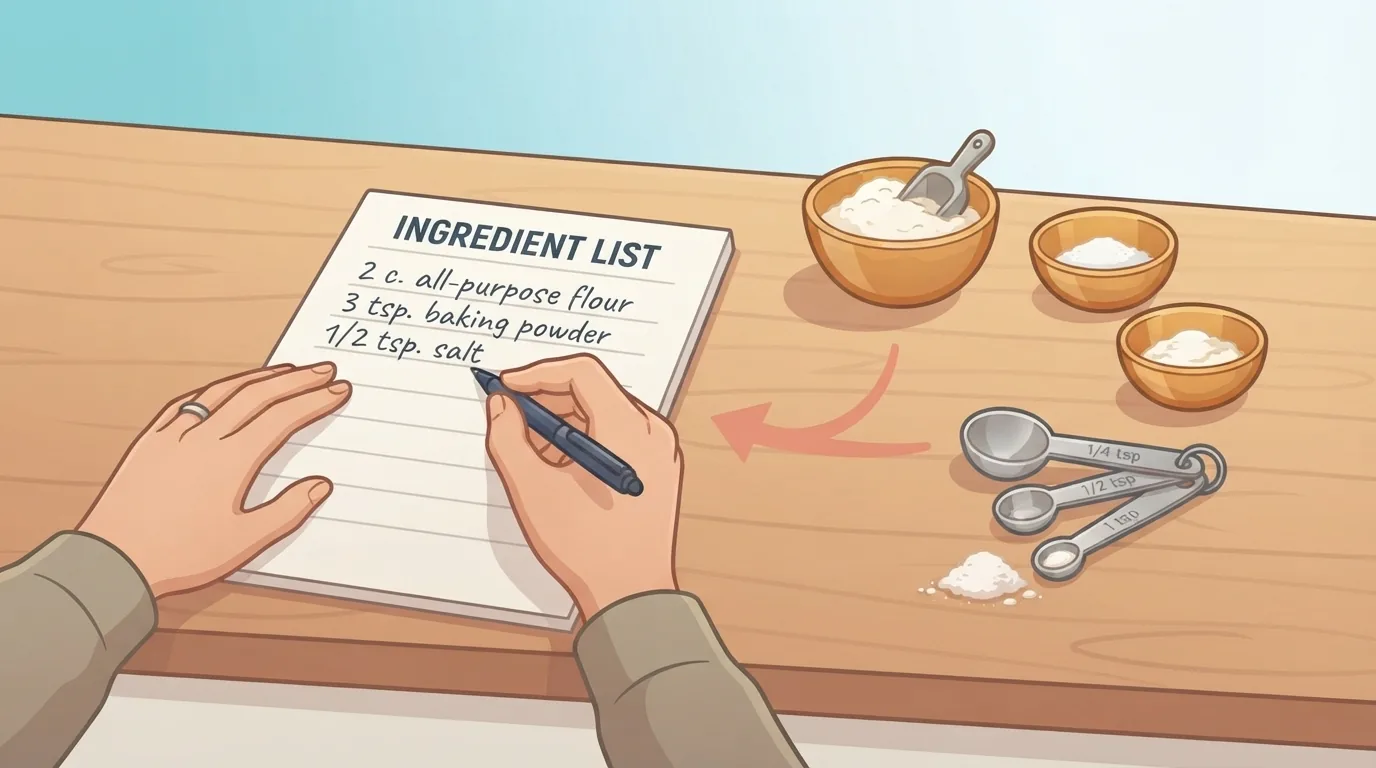
Next to each one, note the price you paid and the package size. Your grocery receipt or the store listing has both.
For this guide we’ll follow one example dish: a pot of tomato soup. Every number below is an example number, not a real market price.
- Canned tomatoes: 56 oz can, $4.20 (example numbers)
- Yellow onions: 3 lb bag, $3.00 (example numbers)
- Olive oil: 16 fl oz bottle, $8.00 (example numbers)
- Heavy cream: 16 fl oz carton, $4.00 (example numbers)
Step 2: Find the Unit Price of Each Ingredient
A unit price is the purchase price divided by the amount in the package. [S3] It lets you cost a recipe that uses only part of what you bought.
Unit price = purchase price ÷ package amount
Take the canned tomatoes. A $4.20 can holding 56 oz works out to $0.075 per ounce. If the soup uses 28 oz, that line costs 28 × $0.075 = $2.10 (example numbers).
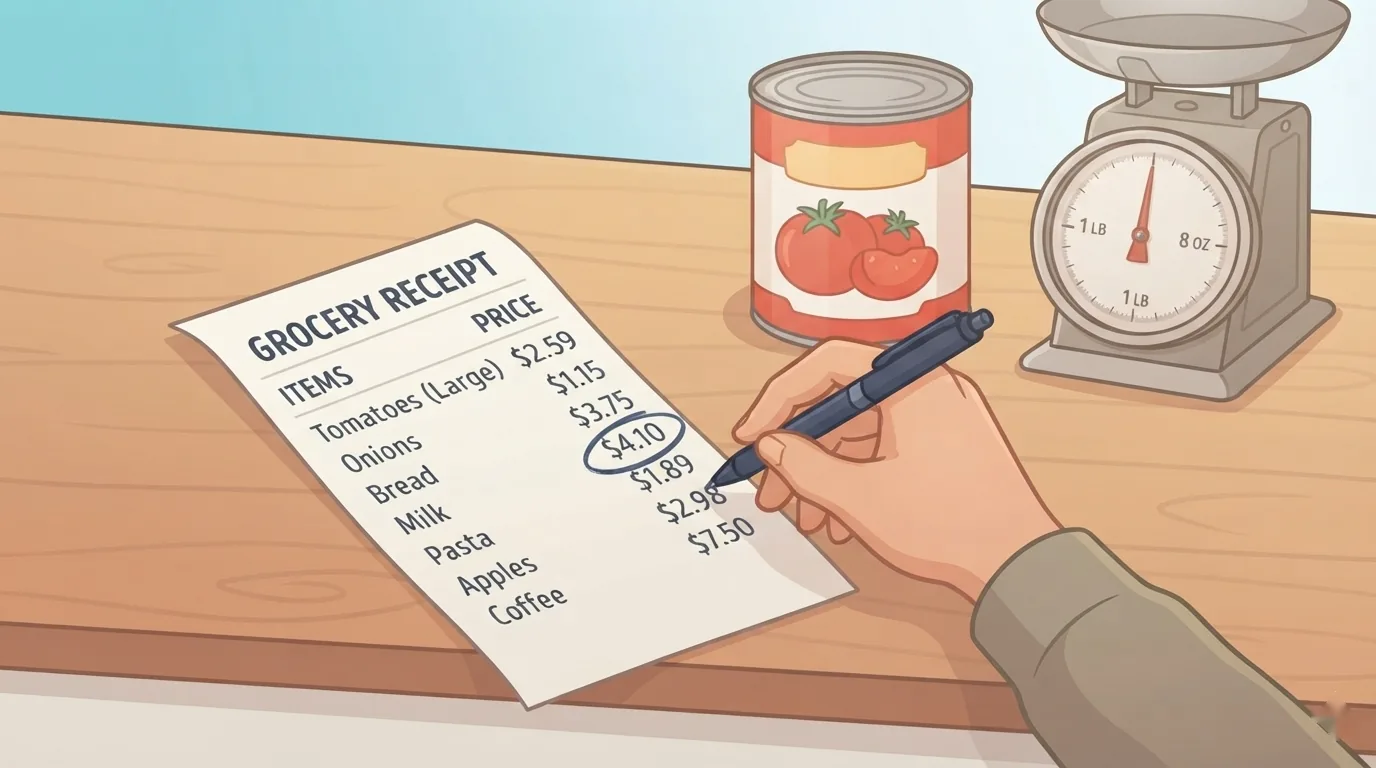
So you pay for the whole can at the register, but the recipe only “uses” half of it. The unit price is how you split that fairly.
Step 3: Match Your Units Before You Multiply
Before you multiply, put the purchase unit and the recipe unit into the same unit. [S3][S4] Multiplying ounces by a price per pound is the quickest way to get a wrong answer.
What if the package is in ounces but the recipe uses cups or tablespoons?
Convert one side so both match. Either turn the recipe amount into the package’s unit, or turn the package amount into the recipe’s unit, then work out the unit price from there.
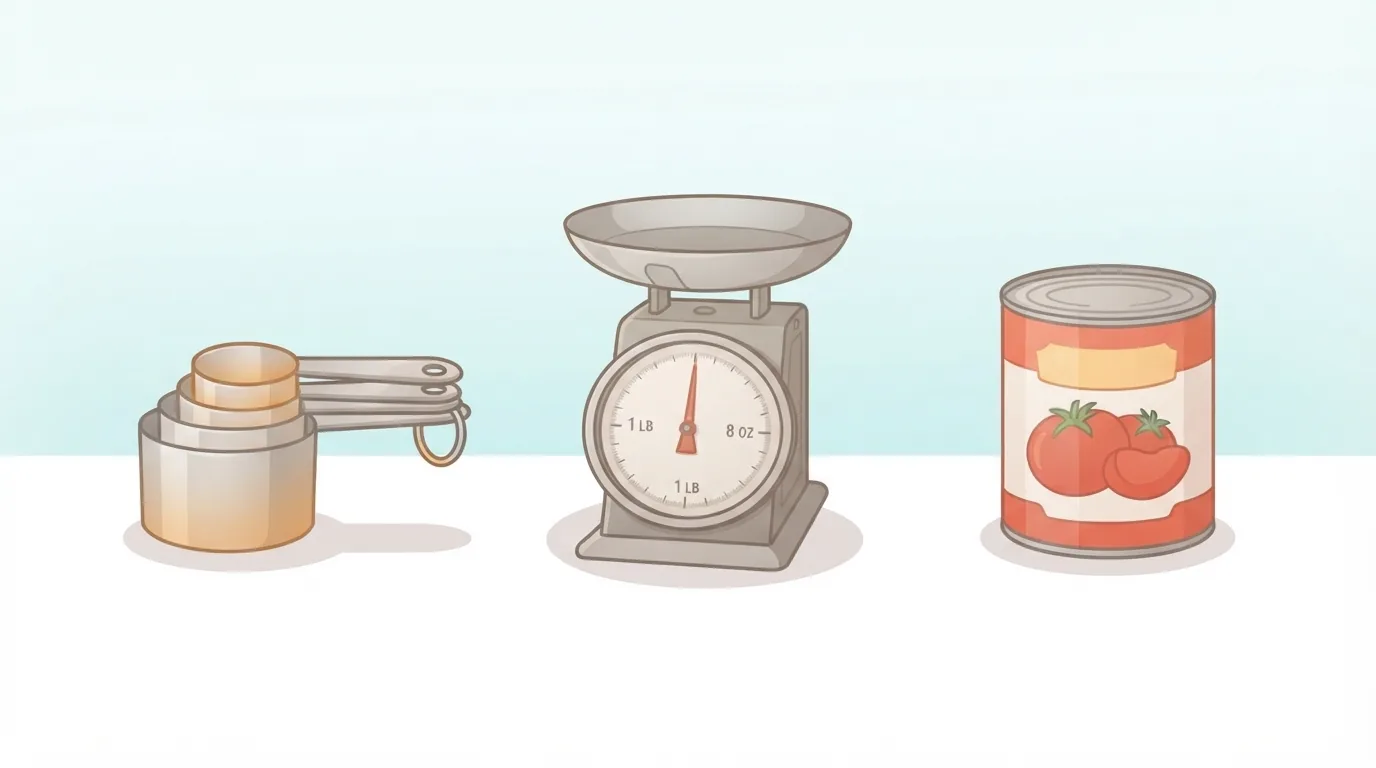
Run through this quick checklist for each ingredient:
- What unit is the package priced in?
- What unit does the recipe use?
- Are they the same? If not, convert one of them.
- Does the unit price use that same unit?
Fluid ounces measure volume, and weight ounces measure weight, so don’t swap them casually. If you’re unsure, our related guide on converting cups, ounces, and grams covers it.
Step 4: Adjust for Trim Loss and Yield
Trim loss means you can’t use everything you buy, so the cost of what you actually use is higher than the sticker math suggests. [S3][S4] Skipping this step makes your recipe look cheaper than it is.
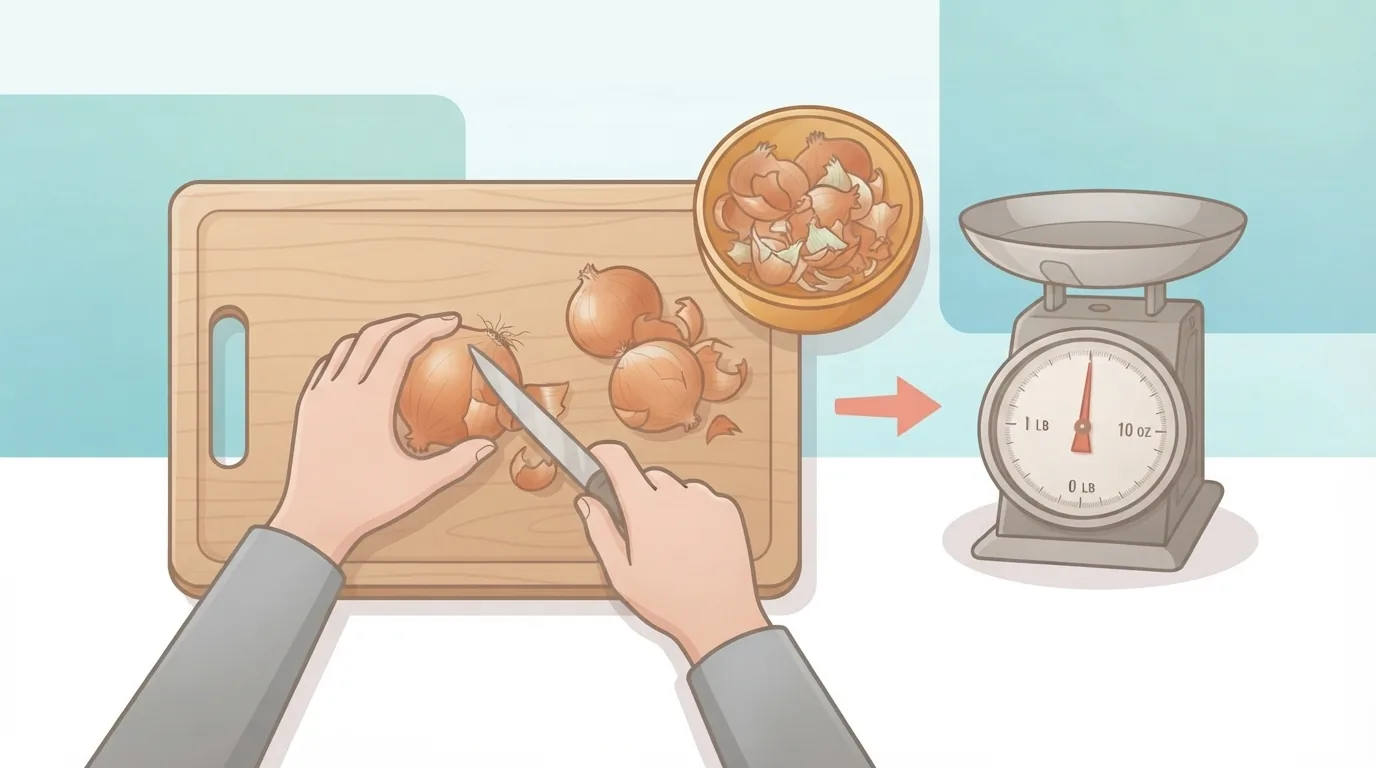
Two short formulas handle it. [S3]
Yield = usable amount after trimming ÷ purchased amount
Edible-portion cost = cost per purchase unit ÷ yield (as a decimal)
🛒 Recommended Product
Here’s an example. You buy 3 lb of onions for $3.00, so $1.00 per lb. After peeling and trimming you have 2.7 lb usable. Yield = 2.7 ÷ 3 = 0.90, and the edible-portion cost = $1.00 ÷ 0.90 = about $1.11 per usable lb (example numbers).
| Onions (example numbers) | Without yield | With yield |
|---|---|---|
| Cost per lb | $1.00 | $1.11 |
| 1.5 lb used in recipe | $1.50 | $1.67 |
Why should yields be measured, not copied from a chart?
Because actual yield depends on the ingredient and how you trim it. [S4] Weigh what you bought, trim it the way you normally do, weigh what’s left, and use your own numbers.
Step 5: Add Up the Batch and Divide by Real Servings
Add every ingredient’s line cost to get the batch total, then divide by the servings the batch actually produced. [S1][S2]
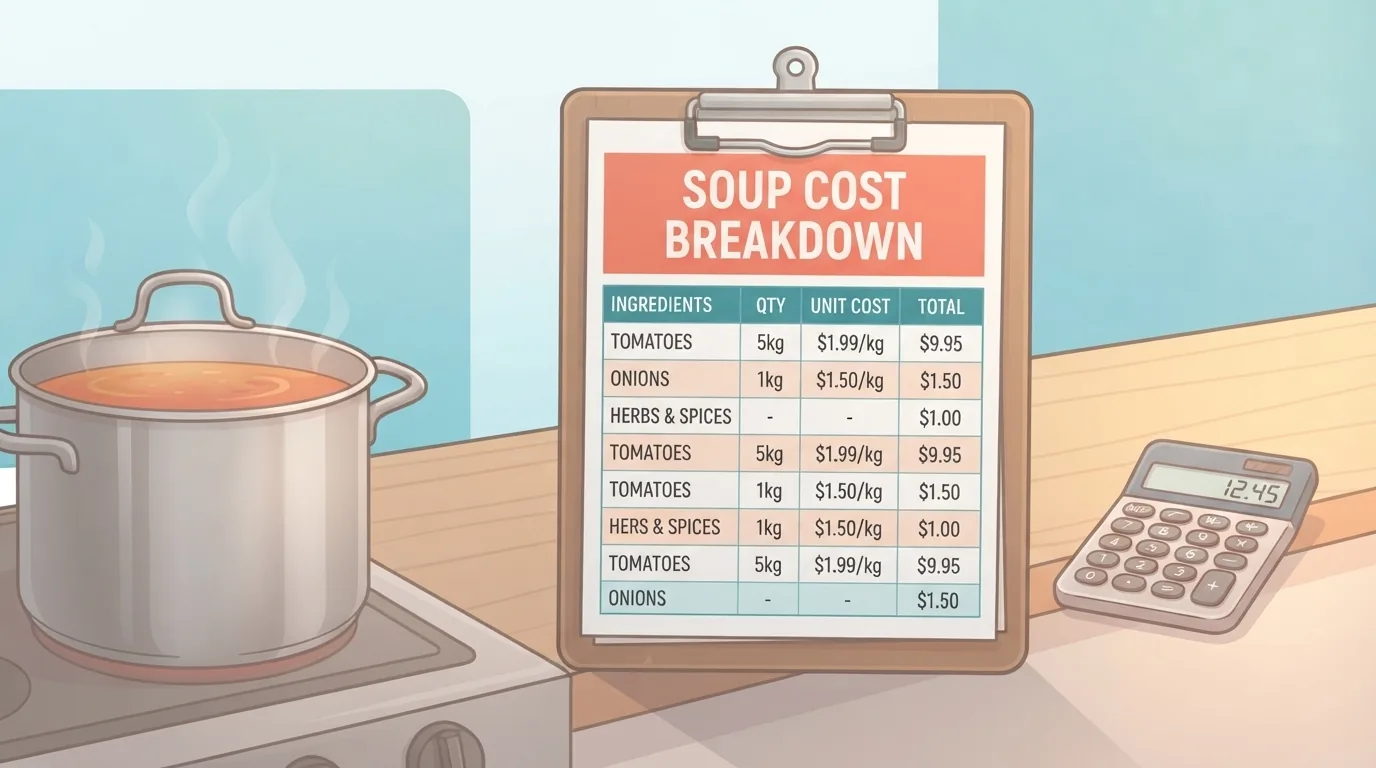
The catch is that the number printed in the recipe isn’t always what you get. If the recipe says “serves 6” but you really ladle out 4 generous bowls, the cost per serving changes. [S1][S2]
For example, a $6.00 batch is $1.00 per serving at 6 servings, but $1.50 per serving at 4 (example numbers).
How do I check the real number of servings?
Measure the finished batch, then divide it by the portion you actually serve. For soup, that might be total cups divided by cups per bowl. Use that count, not the one in the recipe title.
Full Worked Example: From Receipt to Cost Per Serving
Here is the tomato soup costed start to finish, using example numbers only.
| Ingredient | Amount used | Unit price | Line cost |
|---|---|---|---|
| Canned tomatoes | 28 oz | $0.075 per oz | $2.10 |
| Onions (yield-adjusted) | 1 lb usable | $1.11 per lb | $1.11 |
| Olive oil | 2 fl oz | $0.50 per fl oz | $1.00 |
| Heavy cream | 4 fl oz | $0.25 per fl oz | $1.00 |
The batch total is $2.10 + $1.11 + $1.00 + $1.00 = $5.21. If the pot really yields 4 bowls, cost per serving is $5.21 ÷ 4 = about $1.30 (example numbers).
Costing Sauces, Stocks, and Other Sub-Recipes
Cost a sauce or stock as its own recipe first, then carry over only the amount your main dish uses. [S5]
Say you make a batch of basil pesto for $6.00 that yields 12 tablespoons. That’s $0.50 per tablespoon. If your pasta uses 3 tablespoons, add $1.50 to the pasta’s batch total (example numbers).
This keeps you from charging a whole batch of stock to one dish, or forgetting it entirely.
From Cost Per Serving to Food Cost Percentage
Food cost percentage is cost per serving divided by the menu price. [S2][S3][S5]
Food cost % = cost per serving ÷ menu price
With a $1.30 serving sold at $6.50, that’s 1.30 ÷ 6.50 = 20% (example numbers). I won’t give you a “good” target, since the right ratio depends on your ingredients, portions, and where you sell. [S5]
Costing a recipe you cook at home and pricing a menu item are different jobs. Even in a restaurant, this figure leaves out labor, rent, and utilities [S3], plus other costs outside ingredient cost such as packaging and taxes.
Common Mistakes That Make Your Recipe Cost Too Low
Almost every costing error pushes the number down, which makes a recipe look cheaper than it is.
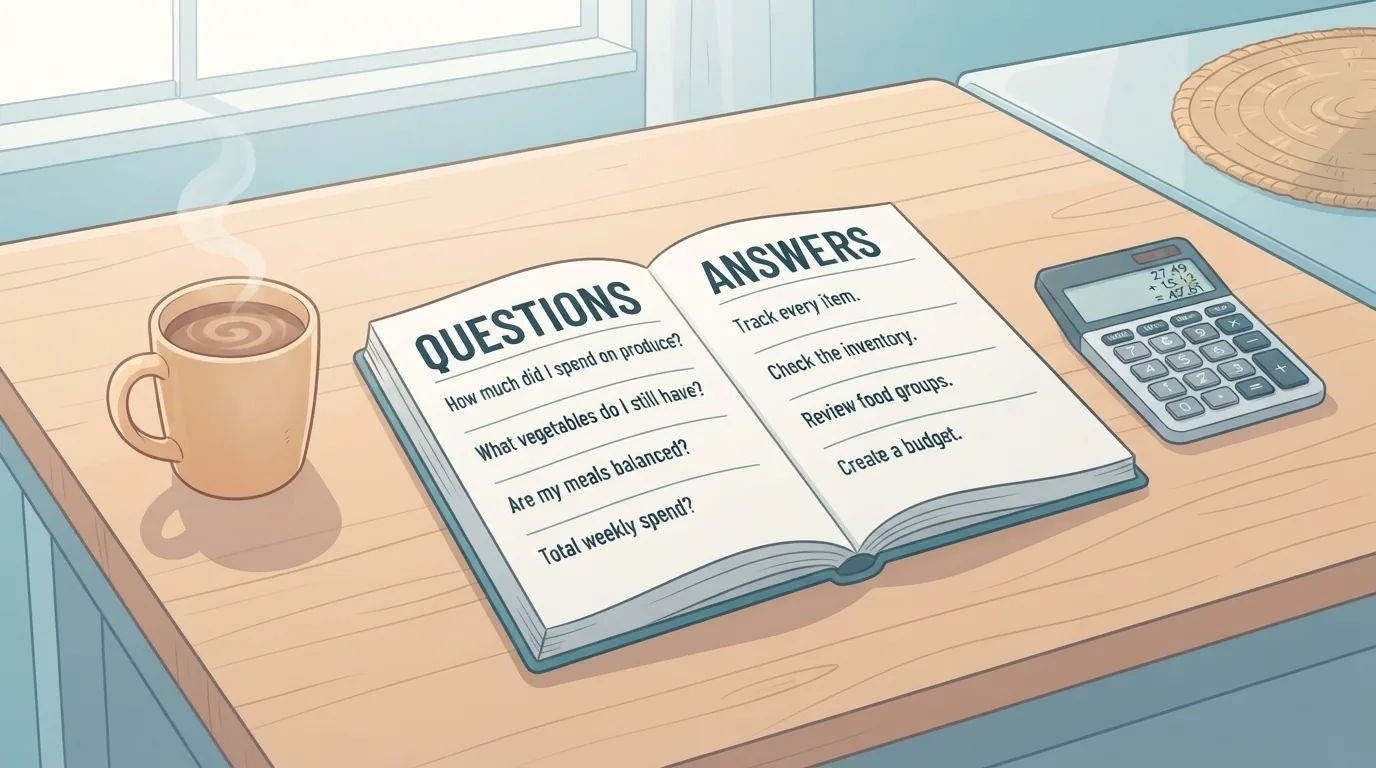
- Ignoring trim loss, so you pay for peels and trimmings without counting them. [S3][S4]
- Forgetting small ingredients like oil, spices, and garnish.
- Using the servings written in the recipe instead of the real count. [S1][S2]
- Mixing units, such as ounces against a per-pound price. [S3][S4]
- Using an old price when your latest receipt shows a new one.
FAQ
Do I include spices and cooking oil?
Yes, I’d include anything the recipe uses, even small amounts. Leaving them out lowers your total, and they add up across a week of cooking.
Can I use a calculator or spreadsheet instead?
Yes. Online recipe cost calculators do the same arithmetic [S4], and you can also build your own spreadsheet. Any tool needs the same inputs: amounts, prices, units, yield, and real servings.
How often should I recalculate?
Recheck when the prices on your receipts change. There’s no fixed interval, because it depends on how often your ingredient prices move.
Is recipe cost the same as profit?
No. Recipe cost covers ingredients only, so profit also depends on labor, rent, utilities, and other costs. [S3]
Quick Recap and Your Next Step
In short, list every ingredient, turn prices into matching unit prices, and adjust for trim loss. Add up the line costs, then divide by the servings you really get. Remember that the result is ingredient cost only.
Today, grab your latest grocery receipt and cost one recipe you cook this week.
Pick one recipe you cook often, pull out your latest receipt, and run these five steps to find its cost per serving.
References
- [S1] U.S. Government Publishing Office (GovInfo), “Recipe Method for Computing Food Costs”: https://www.govinfo.gov/content/pkg/GOVPUB-A-PURL-gpo17149/pdf/GOVPUB-A-PURL-gpo17149.pdf (used for the basic method only)
- [S2][S3] Culinary Institute of America, “CIA Technique of the Quarter: Kitchen Calculations”: https://www.ciachef.edu/wp-content/uploads/2024/07/kitchen-calculations.pdf
- [S4] RestoMetrics, “Recipe Cost Calculator”: https://restaurantmetric.com/tools/recipe-cost-calculator
- [S5] mise, “Recipe costing: how to work out the cost of a dish”: https://www.mise.ws/en/guides/recipe-costing.html
- [S6] Recipee, “How to Cost a Recipe: Step-by-Step with a Worked Example”: https://recipee.app/guides/how-to-cost-a-recipe
Want more comparisons and buying guides?