
⚠️ This page connects you to Atovia’s partners and affiliate markets. We may receive a commission from affiliate partners for activities made through these links. Discount offers may change at any time according to policy! Rest assured, there are no additional costs to you! We hope this saves you time in finding the right items!
You have a birth date and maybe a birth time, and two calculators just gave you two different charts. That is a common frustration, and it usually has a simple cause.
A Four Pillars chart has four pillars: year, month, day and hour. Each pillar is a pair of characters, one Heavenly Stem and one Earthly Branch, which is why the chart is also called the “eight characters.”[1]
So, here is the plan. We will walk through the four pillars in order, then cover the edge cases where results most often differ.
- What Are the Four Pillars in a Saju Chart?
- What Do You Need Before You Start?
- How Do You Find Your Year Pillar?
- How Do You Find Your Month Pillar?
- How Do You Find Your Day Pillar?
- How Do You Find Your Hour Pillar?
- What If You Were Born Near a Boundary?
- Can You Build a Chart Without a Birth Time?
- How Do You Check Your Result?
- Why Do Different Calculators Give Different Charts?
- Frequently Asked Questions
- Your Next Step
- Each pillar is one stem plus one branch, and the 60 stem-branch pairs repeat in a cycle.[2]
- The year changes at the Start of Spring and the month at each solar term, not on January 1 or the 1st of the month.[1]
- The day pillar follows a continuous day cycle and does not depend on the year or solar terms.[1]
- Births near a boundary need an exact check of time, place and calculation method.[3][5]
What Are the Four Pillars in a Saju Chart?
The four pillars are the year, month, day and hour of your birth, each written as two characters.[1] Together they form your chart, called a myeongsik in Korean.
What do the stems and branches mean in a chart?
Each pillar combines one Heavenly Stem with one Earthly Branch. The pairs form a sequence of 60 combinations, and after the 60th the sequence returns to its starting pair.[2]

Why is it also called the eight characters?
Four pillars with two characters each make eight characters in total. In Korean this is saju palja, and in Chinese it is BaZi.[1]
Traditionally, each pillar is read as a different area of life. That belongs to a traditional interpretive system, not a measured fact about any person.

What Do You Need Before You Start?
You need your birth date, birth time, birth place, and whether your date is solar or lunar. Gather these first, because many calculation errors start with a wrong input.
- Confirm whether your birth date is on the solar (Gregorian) or lunar calendar.
- Note your birth time as exactly as you can, ideally from a record.
- Write down the birth place and its time zone.
- Check whether daylight saving time was in effect on that date.
- Decide which method your calculator uses, such as standard time or local solar time.
How Do You Find Your Year Pillar?
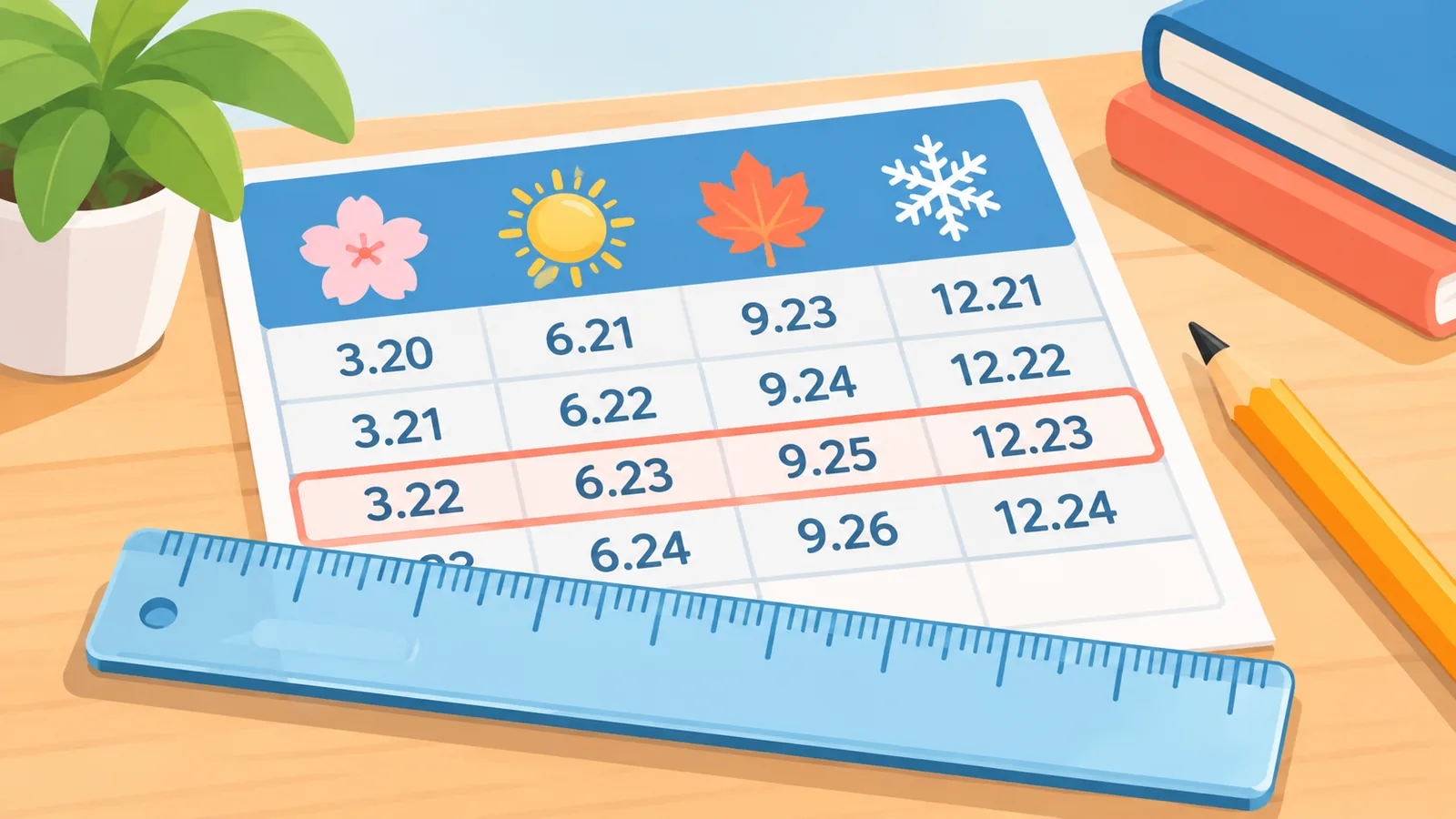
Use the year in which the Start of Spring (Ipchun) falls, not the calendar year. In traditional practice the new year begins at the Start of Spring, so a birth before it takes the previous year’s pillar.[1]

Here’s the catch: the Start of Spring falls in early February, and its exact moment shifts a little from year to year. The Korea Astronomy and Space Science Institute publishes dates and times for the 24 solar terms by year.[3]
So if you were born in January or early February, do not assume your birth year. Look up the Start of Spring time for that year and compare it with your birth moment.
How Do You Find Your Month Pillar?
The month pillar changes at the start of each solar term, not on the 1st of the calendar month.[1] That means a birth early in a calendar month can still belong to the previous Saju month.
Where do the solar terms come from?
The 24 solar terms divide the year according to the Sun’s position along its path.[6] Because they follow the Sun, their calendar dates drift slightly from year to year.
How do you look up the exact change time for your birth year?
Use an official table of solar-term dates and times for your specific year.[3] If your birth is close to the change, compare the exact time, not just the date.

The month’s stem is traditionally derived from the year’s stem using a lookup rule. A calculator or perpetual calendar applies that rule for you.
How Do You Find Your Day Pillar?
The day pillar comes from the day’s place in a continuous cycle of 60 stem-branch pairs.[1][2] You read it from a perpetual calendar (manseryeok) or a calculator rather than working it out from the month.
This cycle does not reset at the Start of Spring or at solar terms.[1] A new year or a new month does not restart the count.
One detail varies: where the day changes. Some tools switch at midnight and others treat the late-night hour differently, so check the rule your calculator uses.[5]
How Do You Find Your Hour Pillar?
Map your birth time to one of 12 two-hour blocks to get the branch, then add the stem based on the day stem.[1][4] The table below shows the commonly used time ranges for each branch.

| Branch | Time block |
|---|---|
| Rat | 11 PM–1 AM |
| Ox | 1–3 AM |
| Tiger | 3–5 AM |
| Rabbit | 5–7 AM |
| Dragon | 7–9 AM |
| Snake | 9–11 AM |
| Horse | 11 AM–1 PM |
| Goat | 1–3 PM |
| Monkey | 3–5 PM |
| Rooster | 5–7 PM |
| Dog | 7–9 PM |
| Pig | 9–11 PM |
Does solar-time correction change the hour pillar?
It can. Some calculators adjust for local solar time based on birth place, and others use standard clock time. Depending on the method, your birth time can land in a different block.[5] This is not a universal rule, so check which one your tool applies.
What If You Were Born Near a Boundary?
If your birth is close to a solar term, a day change or the edge of a two-hour block, confirm it with exact times and a stated method. Do not decide from the date alone.

| Boundary | What changes | What to check |
|---|---|---|
| Start of Spring | Year pillar | Official time for that year[3] |
| Solar term | Month pillar | Term time in your time zone[3] |
| Day change | Day pillar | The calculator’s day-change rule[5] |
| Block edge | Hour pillar | Standard vs. solar time[5] |
Can You Build a Chart Without a Birth Time?
Yes, you can find three pillars (year, month and day), but the hour pillar needs a birth time. Without it, the chart is incomplete.
If you can, check a birth certificate or hospital record. Avoid guessing a time and treating the result as exact, since a wrong block changes the hour pillar.

How Do You Check Your Result?
Compare your result with a second calculator, then look at exactly what differs. Most differences trace back to a handful of settings.
- Use the same solar or lunar input in both tools.
- Use the same time zone and daylight saving setting.
- Check the day-change rule in each tool.
- Check whether solar-time correction is on or off.
- Compare against the Start of Spring and solar-term times for your birth year.
Why Do Different Calculators Give Different Charts?
They use different conventions for the day change, solar time and boundary handling. Detailed rules vary between sources, and no single calculator should be assumed to be the standard.[4][5]
In short, a differing result is a prompt to check the method, not proof that one tool is wrong. Also remember that Saju is a traditional interpretive system. It is not an objective prediction of personality, health or fate.[1]
Frequently Asked Questions
Is the year pillar the same as my birth year?
Not if you were born before the Start of Spring. In that case you use the previous year’s pillar.[1]

Does the month pillar change on the 1st of each month?
No. It changes at the start of each solar term.[1]
Do I need my birth place?
It can matter for the hour pillar if your calculator applies solar-time correction.[5]
Can I find my chart without a birth time?
You can find the year, month and day pillars, but not the hour pillar.
Which calculator is correct?
Conventions differ, so none is automatically the standard. Pick one, note its settings, and use it consistently.[4][5]
Your Next Step
Today, write down your exact birth date, time, place and time zone. Work through the four steps above, then compare your result with one calculator and see where they differ.
Ready to check your work? Enter your birth details in a Saju calculator and compare the result with your hand-checked chart.
References
- Encyclopedia of Korean Culture, “Saju”
- Encyclopedia of Korean Culture, “Ganji”
- Korea Astronomy and Space Science Institute, calendar data
- Data Saju, “How to Read a BaZi Chart Step by Step (With a Worked Example)”
- Chinese Zodiac Compatibility, “How We Calculate Your Four Pillars: A Worked Example”
- Encyclopedia of Korean Culture, “Solar Terms”
Try Atovia’s free tool for this topic →
Want more comparisons and buying guides?
Citing this article
Source: Atovia (Atovia). https://atovia.kr